

Six weeks from now, I'm going to attempt to summit Guadalupe Peak, the highest point in Texas. Today, a 61-year-old guy strapped on 15.6 pounds of gear and went walking around Victoria’s Riverside Park to find out what breaks first.
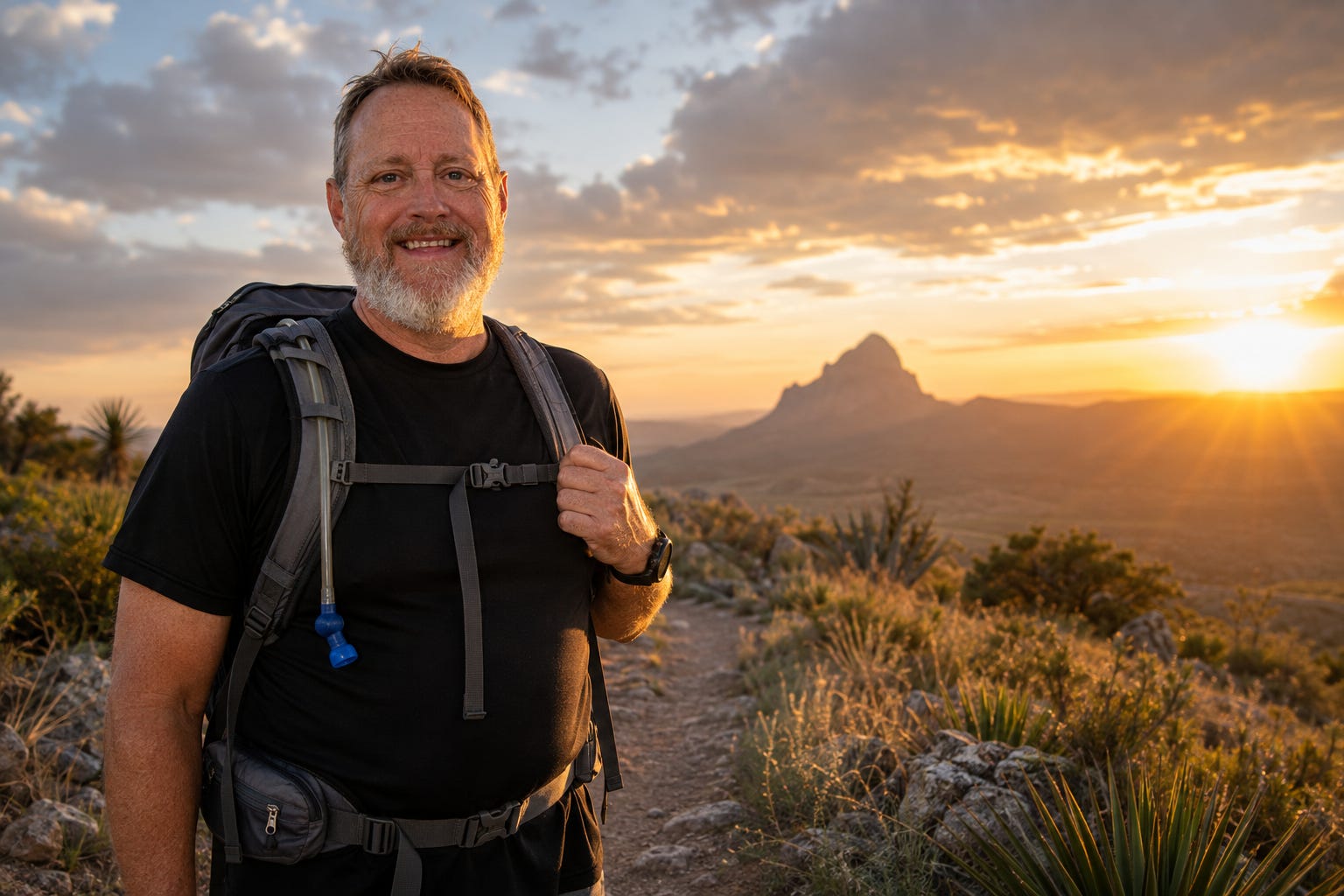
Victoria isn't exactly Nepal. My total elevation gain today was seven feet. But the mountain wasn't available, so this was the next best thing: a full shakedown cruise with the actual two-pack setup I'm planning for summit day. CamelBak underneath for water, Osprey over it for everything else.
Here's what I learned.
The Engine Is Fine. The Chassis Needs Work.
The numbers: 4.32 miles in just under three hours, with an average heart rate of only 105 bpm. That's more than half the distance of the 8.4-mile Guadalupe Peak Trail, carrying the real gear, and I never came close to redlining cardiovascularly.
That's the good news.
The bad news showed up everywhere else. Early on, my knee started tweaking because I'd slipped back into slamming my leg down and hyperextending it. Once I focused on controlling the movement with my quad, the pain went away. Fixable, but a warning: on the mountain, when I'm tired, I can't let fatigue drag me back into bad mechanics.
Then my lower back started talking. I'm used to rucking with a weighted vest that weighs quite a bit more but hugs my whole torso. The Osprey hangs the weight behind me, and after a couple hours, my back noticed. By the time I finished some errands afterward, both hips were so tight I felt about 100 years old getting out of the car.
That's the most important finding of the whole day. My heart handled the workload easily. My back, hips and load-carrying setup are the limiting factors. Now I have six weeks to work on exactly that.
The Water Math
I didn't eyeball my hydration. I weighed the CamelBak before and after, added the electrolyte bottle, and it came out to about 1.57 liters over three hours: roughly 18 ounces per hour. ( I will look and see if that is a good or bad number.)
My original summit plan was 4.5 liters total. Based on today, I'm leaning toward starting with 5. That's another pound on a pack setup I just learned needs work, but running out of water on a mountain in West Texas is a much bigger problem than carrying an extra bottle.
The Phone Passed
One of my biggest questions was whether running GPS navigation for hours would murder my phone battery. Three hours of shooting short clips, hiking, tracking and navigation took it from 100 percent to 81.
That's fantastic. I do not want to discover when I’m ready to grab some photos at the top, that my navigation plan eats the phone. This part of the strategy works.
I also learned how not to save an Organic Maps track (I lost the whole recording), and then, on a second test, how to actually save one. Record, stop, save, verify. Better to fumble that in Victoria than on the trail.
Why Today Was a Win
Not because I walked 4.32 miles.
Today was a success because things went wrong. The knee, the back, the hips, the pack fit, the lost GPS track: every one of those is a problem I now get to solve with six weeks of runway instead of discovering it six miles up a mountain.
That's the whole point of a shakedown cruise.
Guadalupe Peak gets the final vote in October. Today was about finding as many reasons as possible for it to vote yes.
If you want to follow this training project all the way to the summit, subscribe and you'll get every checkpoint along the way.
by Chris Doelle